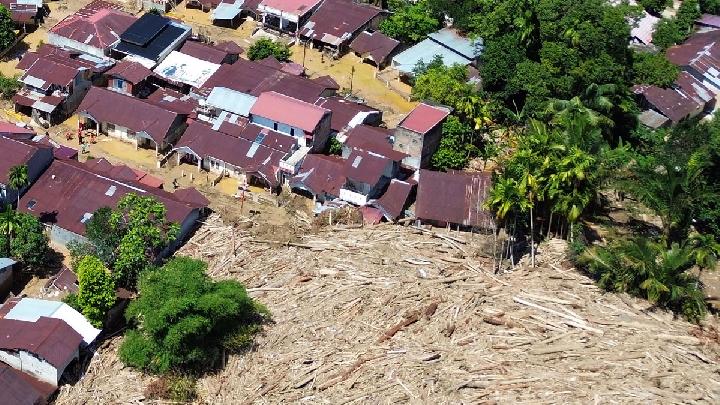
TEMPO.CO, Jakarta - The floods and landslides that swept northern Sumatra last month serve as important lessons on the vital role of climate science in handling hydrometeorological disasters. This was conveyed by Putu Santikayasa, an agrometeorology expert from the Department of Geophysics and Meteorology, Faculty of Mathematics and Natural Sciences at IPB University.
"This incident shows that climate information and analysis play a strategic role in reducing risks, enhancing preparedness, and strengthening community resilience in facing disasters," he said in a written statement on Saturday, December 27, 2025.
He cited widely circulated stories about 50 disaster victims in Sumatra who were stranded in the forests for over 2 days after the floods. "Be careful, the landslides have been blocked by the woods," one resident said at the time, which Putu said indicates how the locals have been spreading word-of-mouth about the trapped landslides upstream before the disaster expanded.
He then explained that the climate conditions that preceded the disasters were not entirely normal. "There were extreme climate conditions during the Sumatra floods," he said. According to him, climate variability in Indonesia is influenced by various phenomena, including the Asian and Australian monsoons, the El Niño-Southern Oscillation (ENSO), the Indian Ocean Dipole (IOD), tropical cyclones, and the Madden-Julian Oscillation (MJO).
Based on his analysis, the IOD was in a weak negative phase during the last ten days of November, and the ENSO showed a weakened La Niña condition. Nonetheless, the emergence of tropical cyclone seeds in the Malacca Strait triggered extreme rainfall and exacerbated the floods in Sumatra.
"The BMKG (Meteorology, Climatology, and Geophysics Agency) recorded 300 millimeters of rainfall in northern Sumatra. In fact, on November 26, daily rainfall reached around 438 millimeters, equivalent to a month's rainfall in a single day," he said.
"These conditions raised the chance for flash floods and widespread landslides," he added.
The Role of Climate Science
Putu emphasized that climate science plays a crucial role in the entire cycle of disaster risk reduction, from pre-disaster, during the disaster, to post-disaster. During the pre-disaster phase, historical data analysis and extreme index can be used to map vulnerable areas and enhance preparedness.
During disasters, climate information supports the development of impact-based forecasting so that emergency responses can be carried out quickly and efficiently. Meanwhile, in the post-disaster phase, long-term climate projections are needed to support the recovery, reconstruction, and adaptation of communities.
"The warning system gives us time to prepare, and adaptive infrastructure gives us the capacity to survive," he stressed that the use of climate science is key to improving resilience to hydrometeorological disasters in the future.
Read: BMKG Outlines Causes of Indonesia's Continuous Rainfall This Year
Click here to get the latest news updates from Tempo on Google News