August 28, 2026 | 03:12 pm

TEMPO.CO, Jakarta - The disaster in the border region between China and Nepal was as sudden as it was unexpected: Within just 10 minutes, enormous volumes of water and debris swept 20 kilometers downstream on Wednesday, with devastating consequences for thousands of people in the region.
Flash floods are a frequent occurrence in the Himalayas. "They are more the rule than the exception," says Niels Hovius, head of the Geomorphology Section at the GFZ Helmholtz Centre for Geosciences in Potsdam. He has worked in the Himalayas and other mountainous regions for many years and is an expert on early warning systems.
What triggered the flash flood?
Scientific data indicate that the disaster began with a glacier collapse in the northern part of the Langtang massif: a large amount of ice broke away and turned into a massive ice avalanche. The Langtang massif is located in central Nepal near the border with China.
"This glacier collapse sent huge amounts of ice rapidly downhill," says Hovius. The heat generated by friction melted the ice into water, which then swept up debris and mud. The resulting mudflow moved downhill at speeds "reached by passenger cars on German highways."
Seismological instruments recorded an earthquake measuring 4.4 on the Richter scale at the time of the glacier collapse. However, Hovius says, it was not a "classic" or tectonic earthquake. Instead, the instruments measured the force of the falling glacier.
Why can flash floods in the Himalayas be so devastating?
Flash floods in high mountain regions can be triggered in different ways — by glacier collapses or by so-called glacial lake outburst floods (GLOFs, or Glacier Lake Outburst Floods).
In such cases, the topography around a glacial lake suddenly changes, for example when a slope collapses into the lake. The large volume of water that suddenly spills over the lake's banks can then turn into torrents rushing downstream. In this particular case, however, it is clear that this was not a GLOF, says Hovius.
Landslides can also cause deadly mudflows without any glaciers or glacial lakes being involved. In the Himalayas, all three types of events are possible, and historical data show that all three occur regularly, Hovius says.
Compared with the Alps, the valleys of the Himalayas are relatively narrow. The water and mud cannot spread out but are instead forced into a confined space, increasing their depth and speed.
In addition to the speed of the water and debris, the extent of the devastation caused by a flash flood depends on how far local populations are from the source.
How can people be protected from flash floods?
Nepal faces two major challenges. Many people have settled along rivers in the valleys of the Himalayas — in precisely the areas that are vulnerable to flash floods. Secondly, there are very few early warning systems in the country, which is one of the poorest in Asia.
Even with a timely warning, the particularly devastating flash flood would have given people only a few minutes to reach safety. Hovius describes a flood that occurred in the same region last year. It was smaller, and therefore less severe. At the time, it took the water an hour to reach a settlement — enough time for people to escape if they had received a timely warning.
"There are initiatives in Nepal to establish local acoustic early warning systems," says Hovius. However, these systems are available only on a very limited scale. At most, they cover one percent of areas at risk. The GFZ researcher adds that mobile phones should be used to send people warnings via push notifications. Hovius is researching how the data needed for such a system could be generated.
Checks should also be made on how settlements are planned, Hovius says. At present, the bulk of a community's infrastructure is concentrated along rivers. "People have moved down from the mountains and settled in the valleys over the past few decades. Perhaps it would make sense to move back to higher ground."
Are flash floods in mountainous areas more frequent amid climate change?
"Attributing individual events to climate change is always difficult," Hovius says. But it is clear that glaciers in high mountain regions become less stable as temperatures rise. Larger volumes of water are also accumulating in glacial lakes, making GLOFs more likely.
As for the current flash flood, it is too early to say whether climbing temperatures caused the glacier to collapse. Flash floods have long been a regular occurrence in the Himalayas. "But I think it is likely that we will see more and more of these events," Hovius says, warning that future disasters could be even more serious.
Read: Trump Offers Aid to Nepal After Deadly Flash Floods
Click here to get the latest news updates from Tempo on Google News
Indonesia Extends Condolences over Nepal-Tibet Flash Floods
16 jam lalu
Approximately 45 Indonesian citizens currently reside in Nepal, but there had been no reports of Indonesian victims in the flash floods.
Nearly 900 Foreigners Missing in Nepal-Tibet Flash Floods
20 jam lalu
Around 900 foreign tourists remained missing in Nepal and China's Tibet region after deadly flash floods and landslides struck the region.
34 Australians Reported Missing Following Nepal Flash Floods
23 jam lalu

Australian Prime Minister Anthony Albanese said that more than 30 Australian citizens are reported missing after flash floods hit Nepal.
UN Deploys Relief Teams, Aid to Flood-Hit Nepal
1 hari lalu
UN is deploying humanitarian aid and personnel to help people affected by flash floods on the China-Nepal border.
Indonesia Confirms No Citizens Affected by Flash Flood in China-Nepal Border
1 hari lalu
Indonesia confirmed that there were no citizens among the hundreds of foreign tourists who died or went missing in the Nepal flash flood.
What Caused the Flash Flood in Nepal-China Border
1 hari lalu
Flash floods leave dozens dead and hundreds missing across the Nepal-China border, with high waters preventing rescue helicopters from landing.
Nepal-China Border Flash Flood Death Toll Hits 160, Hundreds Missing
1 hari lalu
The death toll from flash floods along the Nepal-China border has reached 160, with nearly 300 foreign tourists among hundreds still missing.
UK Heatwave Ends as Thunderstorms Raise Flash Flood Risk
23 hari lalu

UK thunderstorms end the latest heatwave, bringing flash flood risks as forecasters warn another spell of extreme heat could return.
How Past Choices Made Sumatra Flood-Prone
10 Februari 2026
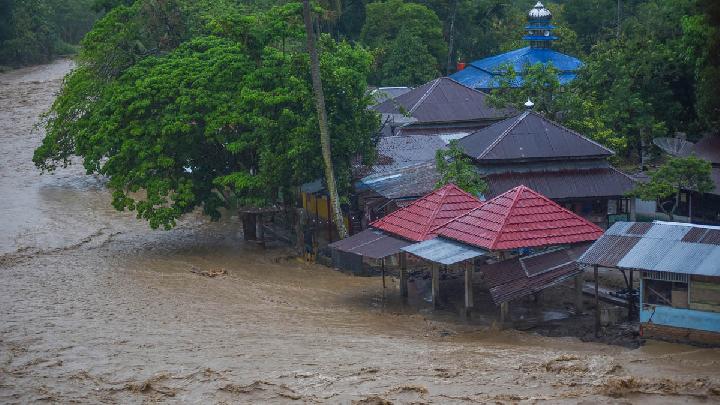
In Sumatra, decades of damaging forest governance decisions degraded landscapes, turning heavy rain into catastrophe.
Flash Floods Hit Tourism Village in Central Java's Jepara Regency
10 Januari 2026
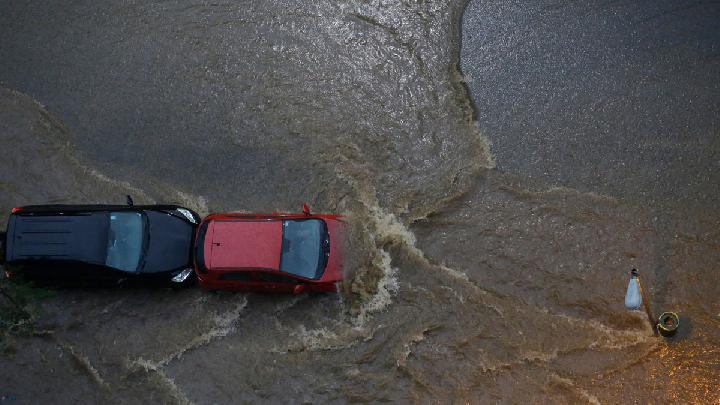
Floods and landslides have struck Tempur Village in Central Java's Jepara Regency on late Friday, January 9, 2026. Residents have evacuated.