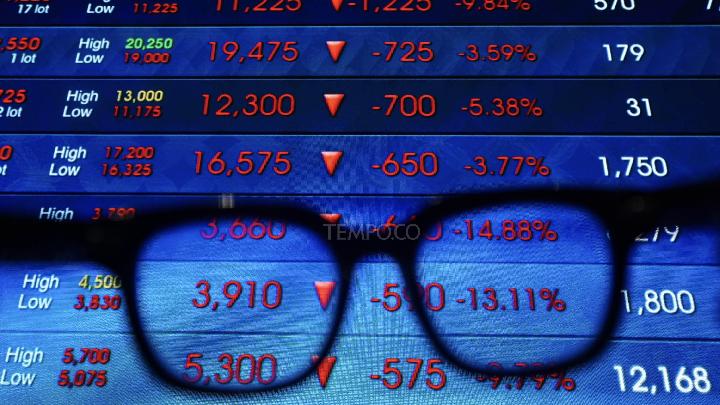
TEMPO.CO, Jakarta - An infographic showing Indonesia is the second-poorest nation globally has been widely circulated on social media platforms, including Instagram [archive], Threads, and Facebook. The post claims to cite official data from the World Bank.
The infographic contains a table listing country names and poverty rates. Zimbabwe is ranked first with a score of 84.2 percent, followed by Indonesia at 60.3 percent, and El Salvador at 25.1 percent. Some posts claim the source is the World Bank's Global Poverty Lines 2025 report. Other posts refer to the Macro Poverty Outlook 2025 report.
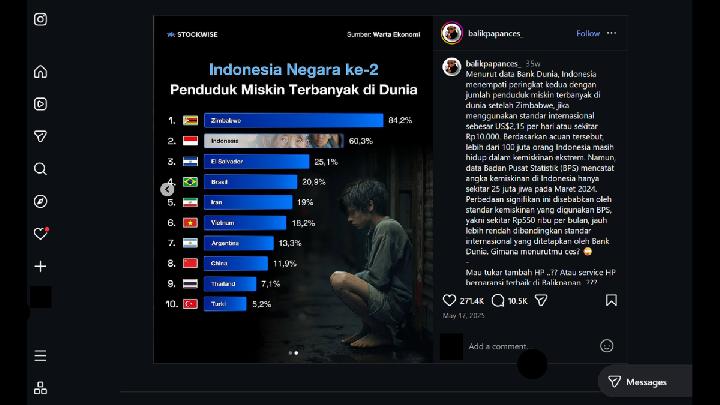
However, is it true that the World Bank released data placing Indonesia’s poverty rate as the second-highest globally?
FACT CHECK
Tempo verified the claim by reviewing the World Bank’s official databases and interviewing macroeconomic researchers. The investigation confirmed that the World Bank has never officially issued a ranking of the poorest countries.
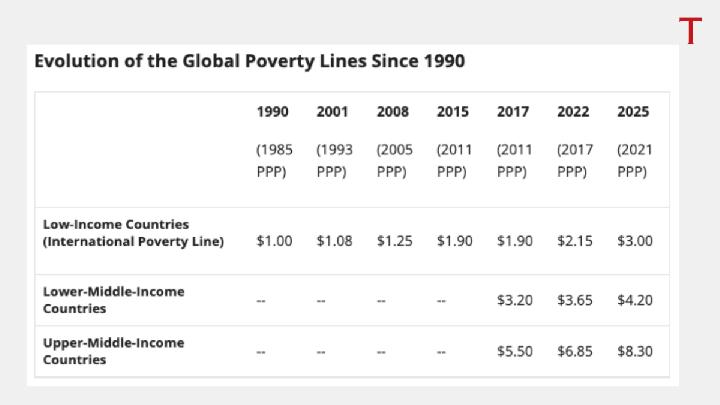
The World Bank classifies nations into three income-based categories: low-income, lower-middle-income, and upper-middle-income. The World Bank's updated Global Poverty Line as of June 2025 established specific thresholds for each of these tiers.
In April 2025, the World Bank released its Macro Poverty Outlook, noting that over 60.3 percent of Indonesia’s population, or roughly 171.8 million people, lived below the poverty line in 2024. This specific line was set at US$8.30 PPP per day, or approximately Rp1,512,000 per capita per month. This figure reflects Indonesia’s specific status as an upper-middle-income country.
What do experts say about the infographic?
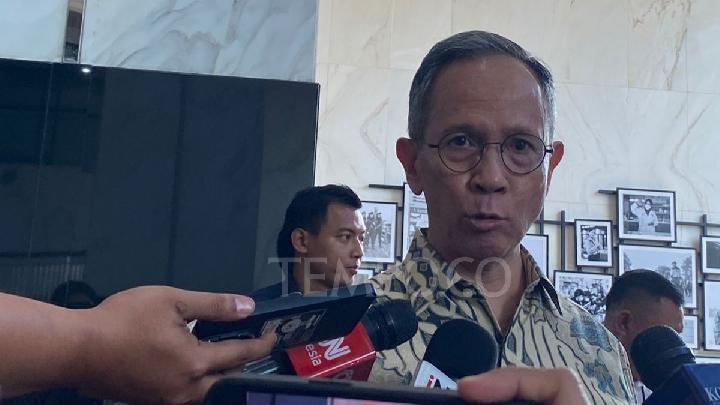
Wisnu Setiadi Nugroho, Coordinator of the Poverty Alleviation and Inequality Study Division at Gadjah Mada University, stated that the World Bank has never released data suggesting Indonesia’s poverty rate is the world's second-highest. Such a ranking is absent from all official documents, including the Global Poverty Line, the Poverty and Inequality Platform (PIP), and the Macro Poverty Outlook.
"None of these three documents mentions Indonesia as the second poorest country in the world," Wisnu told Tempo on Wednesday, January 21, 2026.
According to Wisnu, the World Bank does not officially rank the poorest countries. Furthermore, Indonesia is classified as an upper-middle-income country with extreme poverty rates significantly lower than those in Sub-Saharan Africa. "Indonesia is clearly not among the world's poorest countries, let alone ranked second," the UGM researcher emphasized.
Wisnu noted several approaches that can determine a country's wealth or poverty. Indonesia currently relies on a minimum basic needs approach, primarily covering calorie needs and non-food needs such as housing, clothing, and basic education.
This approach faces criticism for failing to account for transportation costs, internet access, communication, housing density, and risk protection, such as savings and social security.
Esther Sri Astuti, Executive Director of the Institute for Development of Economics and Finance (INDEF), also confirmed the lack of official evidence for the social media claims. She argued that poverty metrics must move beyond simple per capita income.
"It must also be measured through multidimensional aspects such as education, health, and a decent standard of living," Astuti said on Wednesday, January 21, 2026.
What does the World Bank document on poverty contain?
In June 2025, the World Bank published the Global Poverty Lines document. This update follows the release of the International Comparison Program (ICP)'s latest purchasing power parity (PPP) data in May 2024.
PPP serves as the primary tool to convert different currencies into a comparable unit by accounting for price level variations across nations. In other words, PPP ensures currency values are compared based on actual purchasing power rather than exchange rates.
This update established a new international poverty line of US$3.00 per person per day, replacing the previous 2017 PPP-based standard of US$2.15.
The document does not rank countries by poverty level. The World Bank maintains standards for three categories: low-income, lower-middle-income, and upper-middle-income. Global poverty line changes since 1990 are detailed in the table below:
The second document, the Macro Poverty Outlook (MPO), was published in October 2025. It analyzes macroeconomic developments and poverty in 149 developing countries. This report is released twice a year, coinciding with the spring meetings and the annual meetings of the World Bank and the International Monetary Fund.
The MPO consists of country-by-country notes that provide a brief overview of recent developments, projections of key macroeconomic indicators and poverty levels for the period 2025–2027, and a discussion of crucial challenges ahead. These challenges include efforts to stimulate economic growth, maintain macroeconomic stability, and accelerate poverty reduction.
What is the poverty rate in Indonesia according to the World Bank?
The World Bank measures poverty based on international standards that allow for comparisons between countries. The institution uses the Purchasing Power Parity (PPP) approach, which adjusts currency values based on real purchasing power.
For upper-middle-income countries like Indonesia, the poverty line is currently set at US$8.30 PPP per day, or approximately Rp1,512,000 per capita per month. Using this standard, the Macro Poverty Outlook released in April 2025 stated that more than 60.3 percent of Indonesia's population, or approximately 171.8 million people, lived below the poverty line in 2024.
The poverty rate, according to the World Bank, is much higher than that of the Central Statistics Agency (BPS). According to BPS, the national poverty rate as of September 2024 was 8.57 percent, or approximately 24.06 million people. The poverty threshold used is Rp595,242 per capita per month, or approximately Rp19,841 per day.
According to the World Bank, the global standard they set is not intended for domestic policy, but rather as a tool for monitoring progress in poverty alleviation across countries globally. Furthermore, Indonesia's position as an upper-middle-income country is still relatively new and at the lower end. Indonesia's Gross National Income (GNI) per capita in 2023 was recorded at US$4,870, just slightly above the upper-middle-income country threshold, which starts at US$4,516.
Who are the countries with the lowest incomes in the world?
Citing World Data, the 10 poorest countries in the world are in Africa, with Central Africa in first place, followed by Burundi, Mozambique, Sudan, and Somalia. This ranking is based on gross national income (GNI) in 2024.
GNI is the total income generated within a country. However, it is important to note that the value of money varies across countries. The same amount of money can buy very different goods and services, depending on the country in which we live.
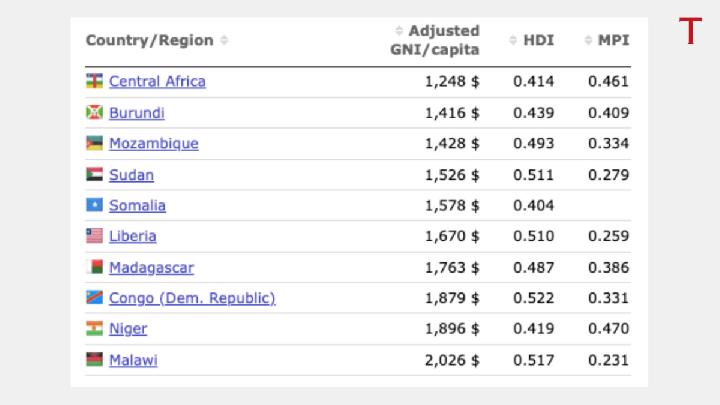
To ensure fair global comparisons, the concept of purchasing power parity (PPP) is used. Through PPP, incomes are adjusted to the price level in each country, making them comparable internationally.
Therefore, the dollar symbol in these reports does not represent US dollars, but rather "PPP dollars"—a conceptual currency used exclusively for comparative analysis.
CONCLUSION
Tempo's verification concludes that the narrative claiming Indonesia is ranked as the world's second-poorest country after Zimbabwe is false.
TEMPO FACT-CHECK TEAM
**Do you have information or claims that you want to have fact-checked? Contact our ChatBot. You can also send criticism, objections, or feedback for this Fact-Checking article via email to [email protected].