TEMPO.CO, Jakarta - The name of Crown Prince Reza Pahlavi has resurfaced amid renewed demonstrations in Iran, as protests against the country’s clerical establishment intensify.
From exile, the former heir to Iran’s monarchy has voiced open support for demonstrators, calling for what he describes as the largest anti-government movement in years, raising questions about his influence and political relevance nearly five decades after the 1979 revolution.
Reza Pahlavi, now 65, has lived outside Iran for almost 50 years, following the overthrow of his father, Shah Mohammad Reza Pahlavi, and the establishment of the Islamic Republic.
While he holds no formal political power, his statements and symbolic status have increasingly drawn attention during periods of unrest.
The Last Crown Prince of Iran
Reza Pahlavi was born on October 31, 1960, into Iran’s ruling royal family. His childhood coincided with a turbulent period in Iranian history, marked by the 1953 coup orchestrated by the United States and Britain that toppled Prime Minister Mohammad Mosaddegh after he nationalized the assets of the Anglo-Persian Oil Company, now BP.
His father, Shah Mohammad Reza Pahlavi, ruled Iran with strong Western backing but faced growing domestic opposition due to widening economic inequality, political repression, and rapid modernization policies that left many Iranians dissatisfied.
Images from the era show the young Reza seated beside his father’s gem-studded throne, symbolizing the continuity of the monarchy.
According to Sky News, the royal family’s lavish lifestyle contrasted sharply with the conditions faced by many Iranians, fueling resentment that ultimately contributed to the 1979 Islamic Revolution.
Reza Pahlavi left Iran shortly before his father was forced to abdicate. He moved to the United States, where he initially pursued training as a combat pilot.
He later wrote that he offered to fight for Iran during the Iran-Iraq War in the 1980s, but his offer was rejected by the new authorities in Tehran.
He went on to earn a degree in political science from the University of Southern California and has since lived in exile in the United States with his wife, Yasmine Pahlavi, and their three daughters.
Support and Controversy in Exile
For decades, Reza Pahlavi has advocated non-violent political change and a national referendum to allow Iranians to decide their future system of governance.
Based largely in Los Angeles and Washington, DC, he has relied on social media and Persian-language news outlets to communicate his views.
His profile rose during major protest movements, including the 2009 demonstrations over disputed election results and the nationwide protests in 2022 following the death of Mahsa Amini.
During those moments, he criticized Iran’s rulers and called for sustained resistance, gaining support among parts of the Iranian diaspora, particularly in the United States and Europe.
Videos circulating online have shown some protesters chanting “Long live the Shah,” while images of Pahlavi have appeared at solidarity rallies in European cities.
However, many demonstrators have focused less on restoring the monarchy and more on broader demands, using slogans such as “down with the dictator,” a reference to Supreme Leader Ayatollah Ali Khamenei.
Iranian state media have portrayed Pahlavi as corrupt and disconnected from the realities inside Iran. Authorities have blamed “monarchist terrorist elements” for violent incidents during protests earlier this month, including attacks on police stations and the burning of vehicles.
Western governments have also stopped short of endorsing him. The United States and European countries, despite long-standing tensions with Tehran, have not formally backed Pahlavi as an opposition leader.
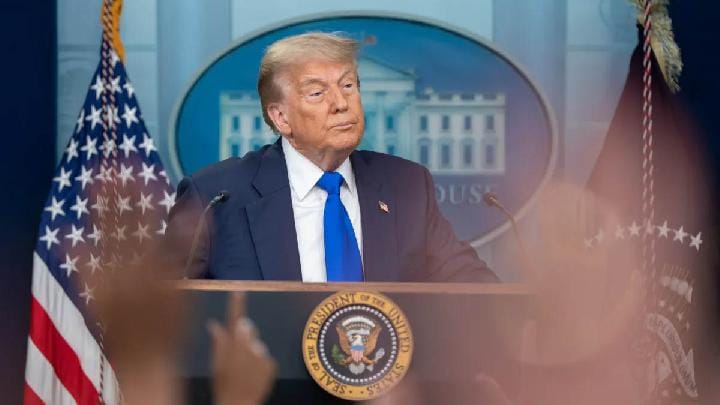
Former US President Donald Trump has said he has no immediate plans to meet him, signaling that Washington remains cautious about openly supporting any single figure.
Branded a ‘Terrorist’ by Tehran
Iranian officials have taken a hard line in response to the unrest. Government-affiliated media have described the demonstrations as a “new phase of insecurity” and even “internal armed war.”
A report in the conservative newspaper Vatan-e Emrooz, quoted by the Tasnim news agency, accused Pahlavi of using protest calls as a cover for “terrorist nuclei” targeting police and Basij forces. Officials have alleged that dozens of security personnel were killed, according to reports cited by Al Jazeera.
Tehran has also linked the unrest to foreign interference, accusing the United States and Israel of orchestrating the protests. Iranian officials have described the demonstrations as a “Plan B” by Washington and Tel Aviv following the end of a brief but intense conflict between Iran and Israel earlier this year.
Ties with Israel
Reza Pahlavi’s relationship with Israel has further fueled controversy. In 2023, he visited Israel and met senior officials, including Prime Minister Benjamin Netanyahu and President Isaac Herzog.
During the visit, he was accompanied by Intelligence Minister Gila Gamliel and participated in official events, including Holocaust Remembrance Day.
Pahlavi has described himself as a supporter of a “secular and democratic Iran,” saying his visit aimed to show that “the Islamic Republic does not represent the Iranian people.” Israel’s right-wing government welcomed the visit, describing him as the most prominent Iranian figure to visit the country.
He also visited the Western Wall but did not comment on Palestine or visit the Al-Aqsa Mosque, a sensitive issue in the region.
Iran and Israel maintained limited economic and consular ties during the reign of Pahlavi’s father, but relations collapsed after the 1979 revolution, turning the two countries into long-standing adversaries.
As protests continue, Reza Pahlavi remains a polarizing figure, viewed by supporters as a symbol of an alternative future, and by critics as a relic of Iran’s past, highlighting the deep divisions within Iran and among Iranians abroad over what change should look like.
Read: Iran's Supreme Leader Posts Image Portraying Trump as Pharaoh
Click here to get the latest news updates from Tempo on Google News