TEMPO.CO, Jakarta - The Indonesian Political Indicators survey institute released the results of its latest survey on satisfaction with President Prabowo Subianto's performance, public trust in state institutions, and satisfaction with the implementation of the Free Nutritional Meals (MBG) program. The survey was published on Sunday, February 8, 2026.
Data collection for this survey was conducted from January 15 to 21, 2026. The sample size was 1,220 eligible voters or those aged 17 or older from all provinces in Indonesia.
The sampling method used was a multistage random sampling method, with a margin of error of approximately 2.9 percent at a 95 percent confidence level. Selected respondents were interviewed face-to-face. The following is a summary of the survey results released by Indonesian Political Indicators.
1. Presidential Performance Satisfaction Rate at 79.9 Percent
Public satisfaction with the performance of the head of state, according to a survey by Indikator Politik, stands at 79.9 percent. This figure consists of 13 percent of the public stating they are very satisfied and 66.9 percent stating they are somewhat satisfied. Meanwhile, 193.3 percent of the public are dissatisfied with President Prabowo Subianto's performance in his first year in office.
Burhanuddin Muhtadi, Executive Director of Indikator Politik Indonesia, stated that Prabowo's approval rating is higher than that of the two previous presidents. "Compared to the early days of Susilo Bambang Yudhoyono's administration in 2004 after the presidential election and Joko Widodo's in 2014 after the first presidential election, Prabowo's approval rating is higher," he said in an online press conference on Sunday, February 8, 2026.
He explained that Prabowo's high approval rating is not solely influenced by the electoral capital he has gained from the Gerindra Party Chairman's base of supporters. According to him, support from former President Jokowi also influenced public satisfaction with Prabowo.
He further detailed that, based on survey results, Prabowo's highest level of public satisfaction was his administration's performance in eradicating corruption. Furthermore, Prabowo's frequent provision of assistance to the public, his firmness, authority, courage, free nutritious meal programs, and improved security were also considered factors that contributed to the president's satisfaction.
Meanwhile, public dissatisfaction with Prabowo's performance was attributed to uneven or misdirected aid distribution, the worsening economy, the difficulty of finding jobs, and the high price of basic necessities. In the same survey, 45.3 percent of respondents stated that the price of basic necessities during Prabowo's administration was much higher than in previous periods.
2. The House of Representatives (DPR) is the Institution Least Trusted by the Public
The level of public trust in the Indonesian House of Representatives (DPR) is below 60 percent. This makes the legislative body the state institution with the lowest level of public trust compared to other institutions.
Burhanuddin Muhtadi, principal researcher at Indikator Politik Indonesia, revealed that the level of public trust in the House of Representatives (DPR) is only 56 percent. "3 percent have strong trust, 53 percent have moderate trust," he said.
Meanwhile, the Indonesian National Armed Forces (TNI) is recorded as the state institution with the highest level of public trust. This national defense institution received a public trust rating of 93 percent, consisting of 15 percent having strong trust and 78 percent having moderate trust.
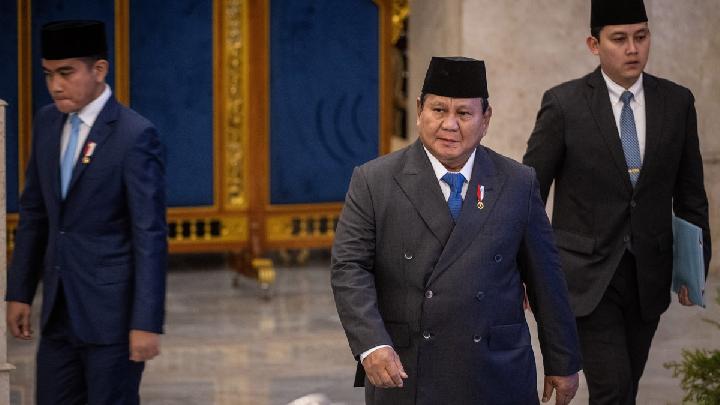
The President is in second place with the highest level of public trust. President Prabowo Subianto's performance in his administration received a public trust score of 91 percent, consisting of 15 percent having strong trust and 76 percent having moderate trust.
Then there is the Attorney General's Office with a public trust rating of 80 percent, the Constitutional Court at 75 percent, the Courts at 74 percent, and the Corruption Eradication Commission at 72 percent. The Indonesian National Police and the Regional Representative Council (DPRD) also received a public trust rating of 65 percent, while political parties received a public trust rating of 61 percent.
3. Public Trust in the Indonesian National Armed Forces (TNI) Declines Due to Expansion of Its Role
Although the TNI holds the highest level of public trust, the Indonesian Political Indicators survey found that the results actually declined compared to the previous survey. This national defense institution received a public trust rating of 93 percent, with 15 percent having strong trust and 78 percent having moderate trust.
Burhanuddin stated that the public trust level in the Indonesian National Armed Forces (TNI) in a previous survey was above 95 percent. He attributed the decline in public trust to the military's expanding role in non-defense matters. "There are already indications of the TNI's involvement in the MBG (National Defense Forces), the Red and White Cooperative, and so on," he said.
He explained that expanding the TNI's role beyond defense matters poses a risk to the institution's image. He believes that military involvement in civilian affairs will increase friction and interaction with the public.
"The more the TNI becomes involved in non-defense matters, the greater the likelihood of interaction with the public, and the potential for friction also increases," Burhanuddin said.
4. Public Satisfaction Level with the MBG: 72.8 Percent
According to a Political Indicators survey, 72.8 percent of the public is satisfied with the implementation of the MBG program implemented during the Prabowo Subianto administration. The figures consisted of 12.2 percent very satisfied and 60.6 percent somewhat satisfied. Meanwhile, 19.9 percent of respondents answered somewhat dissatisfied, and 4.5 percent were not at all satisfied.
Burhanuddin said the majority of respondents who were satisfied with the MBG program were from Generation Z. According to the Indikator survey, 80.7 percent of Gen Z respondents expressed satisfaction with the MBG.
Meanwhile, according to Burhanuddin, respondents living in cities tended to be more dissatisfied with the MBG than those in rural areas. Jakarta had the lowest satisfaction rate at 52 percent. "Jakarta residents have the highest proportion of those dissatisfied with the MBG program," he said.
Indikator Politik also asked about the possibility of corruption in the MBG. The results showed that 2.9 percent of respondents strongly believed the MBG was corrupt, and 30.9 percent believed it was. Meanwhile, 45.6 percent did not believe the MBG was corrupt, 16.1 percent did not believe it was corrupt, and 4.6 percent did not answer.
Sultan Abdurrahman contributed to the writing of this article.
Read: Survey: 72.8% of Indonesians Satisfied with Free Meal Program
Click here to get the latest news updates from Tempo on Google News